
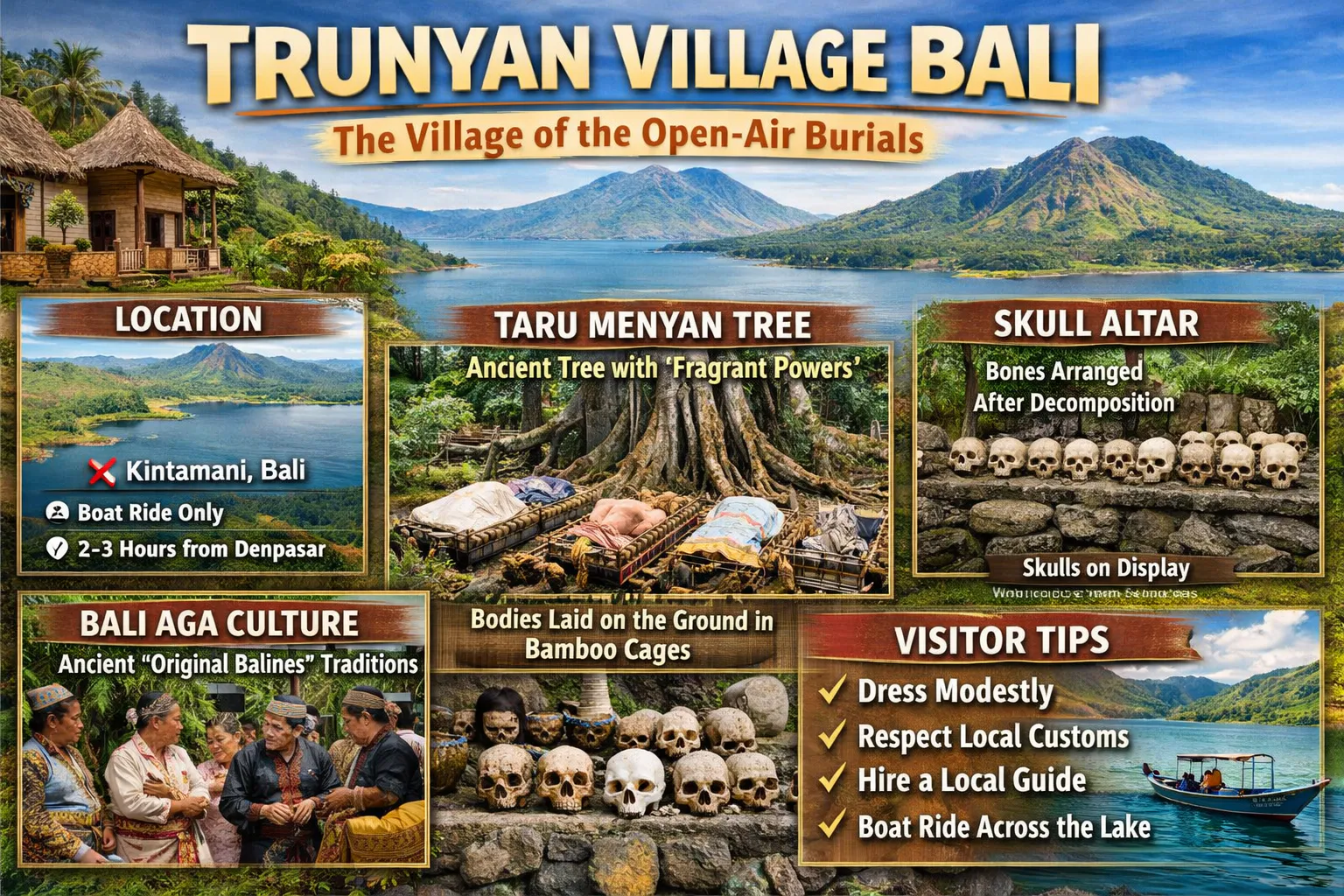
Trunyan Village Bali: The Mysterious Ancient Village with Unique Funeral Traditions
Bali is widely known for its beautiful beaches, vibrant temples, and rich cultural traditions. However, beyond the popular tourist destinations lies a hidden and mysterious place that offers a completely different experience—Trunyan Village. Located on the eastern shore of Lake Batur, this ancient village is one of the most unique cultural destinations in Indonesia.
Unlike most Balinese communities, Trunyan preserves ancient traditions that predate Hindu influence. The village is particularly famous for its unusual burial practices, where the dead are not cremated or buried, but placed openly under a sacred tree.
This article explores everything you need to know about Trunyan Village—from its history and culture to its unique funeral rituals and travel tips.
1. Overview of Trunyan Village
Trunyan Village is located in the Kintamani region of Bali, at the foot of Mount Abang and along the shores of Lake Batur. The village is relatively isolated and can only be accessed by boat, making it one of the most secluded destinations on the island.
The community of Trunyan belongs to the Bali Aga people, also known as the “original Balinese.” These indigenous inhabitants maintain traditions that existed long before the arrival of Hinduism in Bali.
Because of its remote location and strong cultural preservation, Trunyan offers visitors a rare glimpse into Bali’s ancient past.
2. The Bali Aga Culture
The Bali Aga people are considered the earliest settlers of Bali. Unlike the majority of Balinese who practice Hinduism influenced by the Majapahit Empire, the Bali Aga maintain older belief systems rooted in animism and ancestor worship.
In Trunyan, traditions are strictly preserved, including:
- Unique social structures
- Traditional architecture
- Ritual ceremonies
- Ancestral belief systems
Life in the village is simple and largely based on agriculture. Economic activities are limited, and modern influences are minimal compared to other parts of Bali.
This cultural authenticity makes Trunyan one of the most fascinating ethnographic destinations in Indonesia.
3. The Unique Funeral Tradition of Trunyan
3.1 Open-Air Burial System
The most distinctive feature of Trunyan Village is its extraordinary funeral tradition. Unlike typical Balinese cremation rituals (Ngaben), the people of Trunyan do not bury or cremate their dead.
Instead, the deceased are:
- Placed on the ground
- Covered with cloth
- Protected by a bamboo cage (ancak sanji)
- Left to decompose naturally
This practice is known as Mepasah, a ritual that has been preserved for centuries.
3.2 The Sacred Taru Menyan Tree
At the heart of this burial tradition is the legendary Taru Menyan tree, which plays a crucial role in the process.
Taru Menyan Tree
The tree is believed to emit a natural fragrance that neutralizes the smell of decomposing bodies. This phenomenon has fascinated both researchers and visitors for years.
In fact, the name “Trunyan” is derived from:
- Taru = tree
- Menyan = fragrant
3.3 Three Types of Cemeteries
Trunyan has three different burial areas based on the cause of death:
- Sema Wayah – For those who died naturally
- Sema Bantas – For unnatural deaths (accidents, suicide)
- Sema Muda – For children and unmarried individuals
Only married adults who die naturally are placed in the open-air cemetery, making it a highly selective ritual.
3.4 Skull Arrangement Tradition
After the bodies fully decompose, the skulls are collected and placed on a stone altar near the burial site. This creates a haunting yet culturally meaningful display of human remains.
4. Spiritual Beliefs and Philosophy
The funeral traditions of Trunyan are deeply connected to their spiritual beliefs. The villagers worship a local deity known as Ratu Gede Pancering Jagat, who is considered the protector of the community.
Their belief system emphasizes:
- Harmony with nature
- Acceptance of death as a natural process
- Spiritual balance between life and the afterlife
Rather than fearing death, the people of Trunyan view it as a continuation of existence within the natural world.
5. Location and How to Get There
Trunyan Village is located in the Kintamani district, approximately 2–3 hours from Denpasar.
Access Route:
- Drive to Lake Batur area
- Continue to a nearby dock
- Take a boat across the lake (around 20–30 minutes)
Because of its isolated location, visiting Trunyan requires planning and usually the assistance of a local guide.
6. Tourist Experience in Trunyan
6.1 What to Expect
Visiting Trunyan is not a typical Bali experience. It is more cultural and educational than recreational.
Tourists can:
- Explore the traditional village
- Visit the cemetery
- Learn about Bali Aga culture
- Enjoy scenic views of Lake Batur
However, the cemetery can be shocking due to the presence of human remains.
6.2 Cultural Etiquette
Visitors must respect local customs when visiting Trunyan:
- Dress modestly
- Do not touch the bodies or skulls
- Avoid loud behavior
- Follow the guide’s instructions
Respect is essential, as the site is sacred to the local community.
7. Why Trunyan Village is Unique
Trunyan stands out as one of the most unusual tourist destinations in the world because of:
1. Rare Funeral Practices
Open-air burial is extremely rare globally and unique in Bali.
2. Ancient Culture
The Bali Aga traditions preserved here date back to pre-Hindu times.
3. Natural Phenomenon
The Taru Menyan tree adds a mysterious scientific and spiritual element.
4. Remote Location
Its isolation enhances its authenticity and cultural preservation.
8. Pros and Cons of Visiting Trunyan
Advantages
- Unique cultural experience
- Educational and historical value
- Less crowded than mainstream attractions
- Stunning natural scenery
Disadvantages
- Not suitable for sensitive visitors
- Requires boat access
- Limited facilities
- Strong cultural restrictions
9. Travel Tips for Visiting Trunyan
Here are some important tips:
- Visit in the morning for better weather
- Hire a local guide
- Bring cash for boat rental
- Wear comfortable clothing
- Prepare mentally for the cemetery experience
10. Is Trunyan Worth Visiting?
If you are looking for something beyond Bali’s beaches and nightlife, Trunyan is absolutely worth visiting.
It offers:
- A deep cultural experience
- Insight into ancient traditions
- A unique perspective on life and death
However, it is best suited for travelers who are open-minded and respectful of different cultural practices.
Conclusion
Trunyan Village is not just a tourist destination—it is a living cultural heritage site that preserves one of the oldest traditions in Bali. From its mysterious burial practices to its deeply rooted spiritual beliefs, Trunyan offers a rare opportunity to explore a side of Bali that remains untouched by modern tourism.
For those seeking authenticity, history, and cultural depth, Trunyan Village is a destination unlike any other.
