
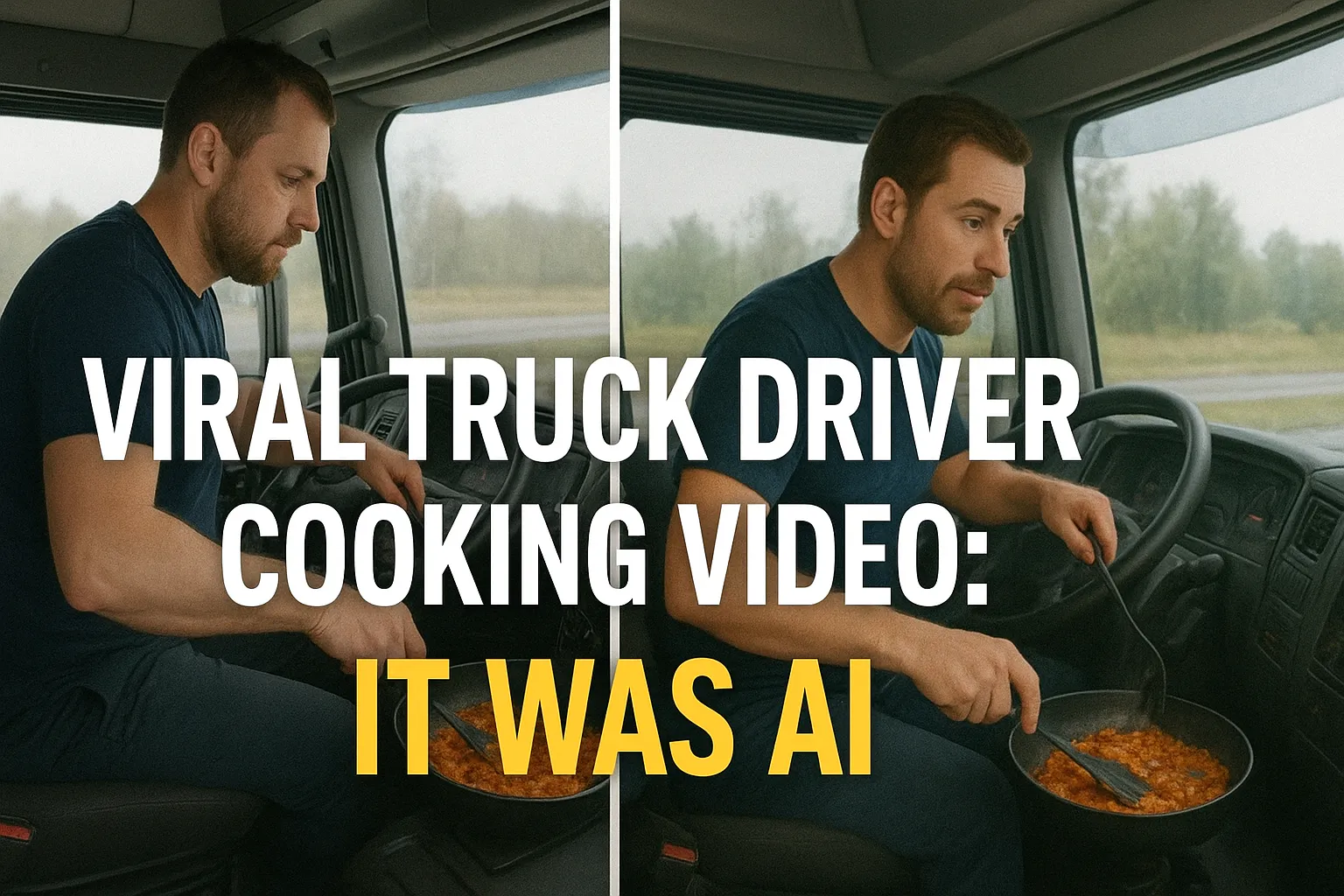
The Truth Behind the Viral “Truck Driver Cooking in His Vehicle” Video — It Was Created by AI
A video showing a truck driver cooking curry inside his truck before crashing into another vehicle went viral this week across multiple social media platforms. However, investigations revealed that the sensational clip wasn’t entirely real — parts of it were created using artificial intelligence (AI).
A Video That Took Over the Internet
The viral clip first surfaced on TikTok and X (formerly Twitter), quickly spreading across India, the United States, and Southeast Asia. It appeared to show a truck driver calmly preparing a curry meal using a gas stove in his cabin before his truck seemingly veered off and collided with a car.
At first glance, the footage looked disturbingly realistic — the flames, the sizzling food, even the reflections on the window glass appeared genuine. Thousands of users commented in shock, criticizing the driver’s recklessness and questioning how such an incident could have happened.
However, within just a few hours, fact-checking teams from India Today and BoomLive began investigating the origins of the clip. What they found was another stark reminder of how powerful and deceptive AI-generated videos have become.
Fact Check: A Mix of Reality and AI Fabrication
According to India Today’s Fact Check division, the video circulating online combined two separate elements:
- A real truck accident that happened in California several months ago.
- AI-generated footage of a driver cooking food in a truck cabin, digitally blended into the crash sequence.
Analysts pointed out subtle inconsistencies that gave away the manipulation:
- The lighting on the driver’s face did not match the shadows inside the cabin.
- The steam and flames had unnatural movement, typical of AI-generated video.
- The reflections in the windshield were distorted, lacking depth perception.
In addition, reverse image searches and metadata analysis revealed that the original truck accident video came from a dashcam uploaded in 2023, while the “cooking” portion appeared to originate from an AI content creator on a channel known for AI satire.
How AI Made It So Convincing
What made this particular video so believable is how AI tools now simulate realistic motion, reflections, and camera noise — details that used to expose manipulated media in the past.
Experts from the Indian Institute of Technology (IIT Delhi) explained that recent generative video models can create frame-consistent motion, meaning each frame aligns perfectly with the previous one, removing visual glitches that used to betray fake videos.
In this case, the creator likely used text-to-video software or a deepfake editor to merge the cooking scene with the truck footage seamlessly. The result? A completely convincing piece of visual misinformation that fooled millions within hours.
The Broader Impact: Trust and Misinformation
This incident highlights a growing problem with viral content in the age of AI. As synthetic media tools become more advanced, it is increasingly difficult for ordinary viewers — and even seasoned journalists — to tell the difference between authentic and fabricated footage.
Social media algorithms, designed to boost emotionally charged content, only make the problem worse. Clips like this gain traction precisely because they provoke shock, disbelief, or outrage.
Digital media analyst Rohan Gupta from Factly India noted:
“AI videos like this one don’t just spread misinformation — they manipulate our emotions. The more believable they look, the faster they spread, and the harder it becomes to correct the narrative.”
Lessons for Viewers and Content Creators
The truck driver video serves as a cautionary tale for both audiences and digital creators. Here are key takeaways from the incident:
- Always verify before sharing. Use reverse image search tools or trusted fact-checking platforms such as India Today Fact Check, Reuters Verify, or AFP Fact Check.
- Look for visual inconsistencies. AI-generated content often shows strange hand movements, unnatural lighting, or background artifacts.
- Check the source account. Many viral AI videos originate from parody or satire pages, not verified news outlets.
- Add disclaimers when reposting. If you share AI-generated content, clearly mention that it is synthetic or speculative to avoid spreading misinformation.
- Stay updated on AI ethics. Understanding how AI content is created helps identify manipulation faster.
Global Reactions and Regulation Challenges
Following this incident, several digital rights organizations have once again urged governments to establish clear labeling standards for AI-generated content. Some experts propose that major social media platforms should automatically tag videos created by AI using digital watermarking.
The European Union has already moved forward with its AI Act, which requires transparency and labeling for synthetic content. Meanwhile, the U.S. and India are still debating how to balance freedom of expression with accountability for deepfake creators.
The Future of Reality in the AI Era
The viral “truck driver cooking” video perfectly encapsulates the new digital dilemma: when everything can be faked perfectly, what can we still trust?
AI is transforming creativity, journalism, and entertainment — but it’s also eroding the line between reality and fabrication.
As viewers, we must adapt quickly. Critical thinking, media literacy, and responsible sharing are now essential survival tools in the information ecosystem.
In the end, the lesson is simple: don’t believe everything that looks real — even if it feels real.
The next viral video you see might not just be entertainment or news. It could be an algorithm’s creation, designed to make you react before you think.
References :
- BoomLive. (2025, October 26). Fact Check Report: Viral truck driver cooking video created with AI. BoomLive Digital Verification Report.
- Gupta, R. (2025, October 27). AI-generated misinformation and emotional manipulation on social media. Factly India.
- India Today. (2025, October 27). Fact Check: Viral video of truck driver cooking before crash was made with AI. India Today Fact Check Division.
- Indian Institute of Technology Delhi. (2025). Media forensics and detection of AI-generated videos: 2025 research report. IIT Delhi, Media Forensics Research Group.
- Reuters. (2025, October 28). AI deepfakes and the rise of synthetic viral videos. Reuters Fact Check.
